Environmental Medicine and Toxicology

Environmental Medicine and Toxicology

Addressing the silent threat - Strategies to reduce lead exposure in opium-user populations: Integrating health and policy

Document Type : Policy Briefs

Authors
1 Substance Abuse Prevention Research Center, Health Institute, Kermanshah University of Medical Sciences, Kermanshah, Iran
2 Medical Toxicology and Drug Abuse Research Center, Birjand University of Medical Sciences, Birjand, Iran
3 University of Maryland, Baltimore: Baltimore, Maryland, US
Abstract
Background and Objectives: Earlier literature on Iran points to a critical public health issue regarding elevated blood lead levels (BLLs) among individuals who use opium, either through oral ingestion or inhalation. The findings emphasize the health risks faced by this vulnerable group, highlighting the urgent need for targeted interventions.
Methods: This article presents a health policy brief aimed at policymakers and healthcare authorities concerning this at-risk population in Iran.
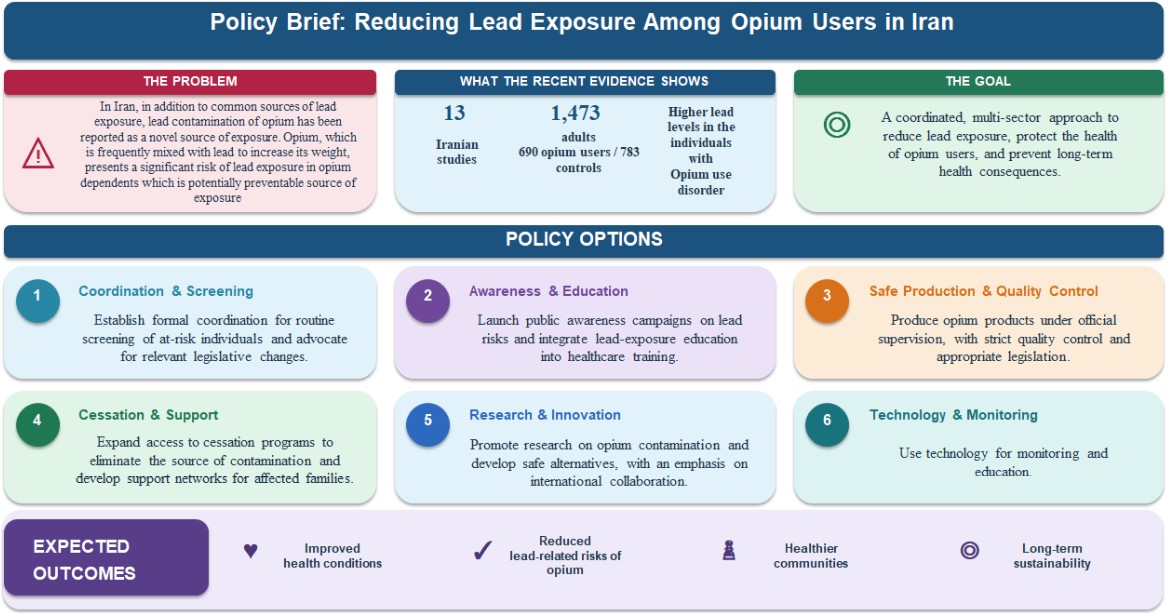
Policy Options: This policy brief advocates for a multi-faceted strategy to address lead exposure among opium users. Six policy options are proposed: 1. Establish formal coordination for routine screening of individuals at risk of lead exposure related to opium use and advocate for relevant legislative changes; 2. Enhance public awareness campaigns about the risks of lead exposure associated with opium use and integrate lead exposure education into healthcare training; 3. Regulate the production of opium products under official supervision and implement necessary quality control measures through relevant legislation; 4. Expand access to cessation programs to eliminate the source of contamination and develop support networks for affected families; 5. Promote research on opium contamination and the development of safe opium alternatives, focusing on international research collaboration; 6. Utilize technology for monitoring and educational purposes.
Conclusion: By emphasizing awareness, screening, research, community support, and targeted interventions, we can improve health outcomes and reduce lead-related risks for individuals with opium use disorder.

Graphical Abstract

Addressing the silent threat - Strategies to reduce lead exposure in opium-user populations: Integrating health and policy

Highlights

  • A multi-faceted strategy toward blood lead exposure among opium users is needed.
  • Increasing public awareness, stricter regulations, expanded cessation programs, and collaboration among stakeholders should be considered.
  • Placing emphasis on research, community support, and targeted interventions leads to the improvement of health conditions and a decrease in lead-related risks.

Keywords
Subjects

[1] Collin, M.S., et al., Bioaccumulation of lead (Pb) and its effects on human: A review. J Hazard Mater Adv, 2022. 7: https://doi.org/100094. 10.1016/j.hazadv.2022.100094
[2] Gonzalez-Villalva, A., et al., Lead systemic toxicity: A persistent problem for health. Toxicol, 2025. 515: 154163. https://doi.org/10.1016/j.tox.2025.154163
[3] Generalova, A., S. Davidova, and G. Satchanska, The mechanisms of lead toxicity in living organisms. J Xenobiotics, 2025. 15(5): 146. https://doi.org/10.3390/jox15050146
[4] Azadi, N., et al., Multivariate statistical evaluation of heavy metals in the urine of opium individuals in comparison with healthy people in Western Iran. Environ Sci Poll Res, 2022: 1-10. https://doi.org/10.1007/s11356-021-16271-6
[5] Farnia, V., et al., Blood lead concentration among oral/inhaled opium users: systematic review and meta-analysis. Crit Rev Toxicol, 2021. 51(1): 24-35. https://doi.org/10.1080/10408444.2020.1864722
[6] Mansouri, B., et al., Trace element levels: How Substance Use Disorder (SUD) contributes to the alteration of urinary essential and toxic element levels. Plos ONE, 2024. 19(2): e0294740. https://doi.org/10.1371/journal.pone.0294740
[7] Mehrpour, O., et al., Comparison of vitamin B12, vitamin D, and folic acid blood levels in plumbism patients and controls in eastern Iran. Biol Trac Elem Res, 2021. 199: 9-17. https://doi.org/10.1007/s12011-020-02119-6
[8] Soltaninejad, K. and S. Shadnia, Lead poisoning in opium abuser in Iran: A systematic review. Int J Prev Med, 2018. 9. https://doi.org/10.4103/ijpvm.IJPVM_22_17
[9] Tabrizi, R., et al., A systematic review and meta-analysis on blood lead level in opium addicts: An emerging health threat. Biol Trace Elem Res, 2021. 199: 3634-3641. https://doi.org/10.1007/s12011-020-02504-1
[10] Moghadam, A.T., M. Bahreini, and B.C. Anzali, Opium-related lead toxicity: an integrative review and case series. J Emerg Med, 2020. 59(1): 33-45. https://doi.org/10.1016/j.jemermed.2020.04.020
[11] Alinejad, S., et al., Clinical aspects of opium adulterated with lead in Iran: a review. Basic Clin Pharmacol Toxicol, 2018. 122(1): 56-64. https://doi.org/10.1111/bcpt.12855
Volume 1, Issue 1
Summer 2026
Pages 47-52

  • Receive Date 25 August 2026
  • Revise Date 24 September 2026
  • Accept Date 24 September 2026
  • First Publish Date 24 September 2026
  • Publish Date 27 September 2026