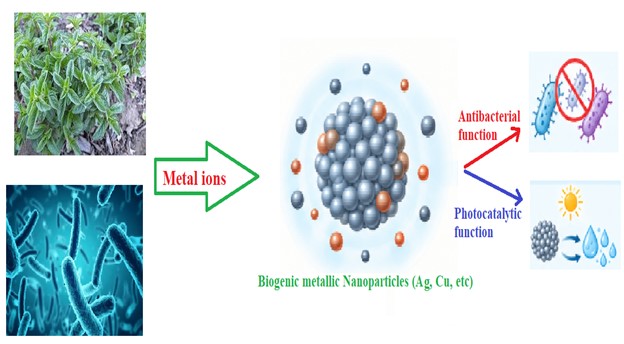
Background and Objectives: Multidrug-resistant (MDR) bacteria have emerged as a major global public health concern, substantially limiting the effectiveness of conventional antibiotic therapies and increasing the urgent need for safe, effective, and sustainable alternative antimicrobial agents. In parallel, environmental pollution and the presence of persistent microbial contaminants in water have highlighted the need for innovative treatment technologies. This policy brief aims to provide a comprehensive overview of the antibacterial and photocatalytic properties of biosynthesized silver (Ag) and copper (Cu) nanoparticles and nanocomposites, with particular emphasis on their potential applications in antimicrobial control and environmental remediation. Methods: A literature review was conducted focusing on recent studies investigating the green biosynthesis of Ag- and Cu-based nanoparticles and nanocomposites using medicinal plants and bacteria. The reported antibacterial mechanisms, photocatalytic performance, environmental applications, and potential advantages of biogenic synthesis were critically examined. Policy Options: Biogenic Ag and Cu nanoparticles exhibit enhanced antibacterial and photocatalytic activities against a broad range of microorganisms and environmental contaminants. Their unique physicochemical properties, combined with the use of biological reducing and stabilizing agents, make them promising alternatives to conventional antimicrobial agents and emerging water treatment technologies. Conclusion: Biogenic nanoparticles and nanocomposites synthesized using medicinal plant species and bacteria represent a promising, eco-friendly, and potentially biocompatible approach for addressing antimicrobial resistance and environmental pollution. Further research should focus on optimizing synthesis conditions, elucidating mechanisms, evaluating long-term environmental safety, and facilitating their practical application.
Graphical Abstract
Highlights
Biogenic Ag and Cu nanoparticles exhibit strong antibacterial activity against MDR bacteria.
Green biosynthesis using medicinal plants and bacteria provides an eco-friendly approach.
Ag- and Cu-based nanocomposites show promising photocatalytic potential for environmental remediation.
Biogenic nanomaterials offer sustainable alternatives for antimicrobial control and water treatment.
[1] Alavi M, Karimi N. Characterization, antibacterial, total antioxidant, scavenging, reducing power and ion chelating activities of green synthesized silver, copper and titanium dioxide nanoparticles using Artemisia haussknechtii leaf extract. Artif Cells Nanomed Biotechnol. 2018; 46(8): 2066-2081.https://doi.org/10.1080/21691401.2017.1408121
[2] Martens E, Demain AL. The antibiotic resistance crisis, with a focus on the United States. J Antibiot. 2017; 70(5): 520-526. https://doi.org/10.1038/ja.2017.30
[3] Alavi M, Moradi M. Different antibacterial and photocatalyst functions for herbal and bacterial synthesized silver and copper/copper oxide nanoparticles/nanocomposites: A review. Inorg Chem Commun. 2022; 142: 109590.https://doi.org/10.1016/j.inoche.2022.109590
[4] Ma B, Sun B, Huang Y, Chen C, Sun D. Facile synthesis of Cu nanoparticles encapsulated into carbonized bacterial cellulose with excellent oxidation resistance and stability. Surf A: PhysicochemEng Asp. 2020;590:124462.https://doi.org/10.1016/j.colsurfa.2020.124462
[5] Pourzahedi L, Eckelman MJ. Comparative life cycle assessment of silver nanoparticle synthesis routes. Environ. Sci. Nano. 2015;2(4):361-9.https://doi.org/10.1039/c5en00075k
[6] Patiño-Ruiz DA, Meramo-Hurtado SI, González-Delgado ÁD, Herrera A. Environmental sustainability evaluation of iron oxide nanoparticles synthesized via green synthesis and the coprecipitation method: A comparative life cycle assessment study. ACS omega. 2021;6(19):12410.https://doi.org/10.1021/acsomega.0c05246
[7] Lead JR, Batley GE, Alvarez PJ, Croteau MN, Handy RD, McLaughlin MJ, et al. Nanomaterials in the environment: behavior, fate, bioavailability, and effects—an updated review. Environ. Toxicol. Chem. 2018;37(8):2029-63.https://doi.org/10.1002/etc.4147
[8] Aiken GR, Hsu-Kim H, Ryan JN. Influence of dissolved organic matter on the environmental fate of metals, nanoparticles, and colloids. ACS Publications; 2011: 3196-3201.https://doi.org/10.1021/es103992s
[9] Keller AA, McFerran S, Lazareva A, Suh S. Global life cycle releases of engineered nanomaterials. J Nanoparticle Res. 2013;15(6):1692.https://doi.org/10.1007/s11051-013-1692-4
[10] Levard C, Hotze EM, Lowry GV, Brown Jr GE. Environmental transformations of silver nanoparticles: impact on stability and toxicity. Environ Sci Technol. 2012;46(13):6900-14.https://doi.org/10.1021/es2037405
[11] Yong DW, Lieu ZZ, Cao X, Yong XE, Wong JZ, Cheong YS, et al. Biogenic synthesis of silver nanoparticles with high antimicrobial and catalytic activities using Sheng Di Huang (Rehmannia glutinosa). Chem: Asian J. 2021;16(3):237-46.https://doi.org/10.1002/asia.202001146
[12] Kambale EK, Nkanga CI, Mutonkole B-PI, Bapolisi AM, Tassa DO, Liesse J-MI, et al. Green synthesis of antimicrobial silver nanoparticles using aqueous leaf extracts from three Congolese plant species (Brillantaisia patula, Crossopteryx febrifuga and Senna siamea). Heliyon. 2020;6(8).https://doi.org/10.1016/j.heliyon.2020.e04493
[13] Mehdizadeh T, Zamani A, Froushani SMA. Preparation of Cu nanoparticles fixed on cellulosic walnut shell material and investigation of its antibacterial, antioxidant and anticancer effects. Heliyon. 2020;6(3).https://doi.org/10.1016/j.heliyon.2020.e03528
[14] Taran M, Rad M, Alavi M. Antibacterial activity of copper oxide (CuO) nanoparticles biosynthesized by Bacillus sp. FU4: optimization of experiment design. Pharm Sci. 2017; 23(3): 198-206.https://doi.org/10.15171/PS.2017.30
[15] Rad M, Taran M, Alavi M. Effect of incubation time, CuSO4 and glucose concentrations on biosynthesis of copper oxide (CuO) nanoparticles with rectangular shape and antibacterial activity: Taguchi method approach. Nano Biomed Eng. 2018;10(1):25-33.https://doi.org/10.5101/nbe.v10i1.p25-33
[16] Salem SS, El-Belely EF, Niedbała G, Alnoman MM, Hassan SE-D, Eid AM, et al. Bactericidal and in-vitro cytotoxic efficacy of silver nanoparticles (Ag-NPs) fabricated by endophytic actinomycetes and their use as coating for the textile fabrics. Nanomater. 2020;10(10):2082.https://doi.org/10.3390/nano10102082
[17] Graves Jr JL, Tajkarimi M, Cunningham Q, Campbell A, Nonga H, Harrison SH, et al. Rapid evolution of silver nanoparticle resistance in Escherichia coli. Front Genet. 2015;6:42.https://doi.org/10.3389/fgene.2015.00042
[18] Hochvaldová L, Panáček D, Válková L, Večeřová R, Kolář M, Prucek R, et al. E. coli and S. aureus resist silver nanoparticles via an identical mechanism, but through different pathways. Commun Biol. 2024;7(1):1552.https://doi.org/10.1038/s42003-024-07266-3
[19] Mann R, Holmes A, McNeilly O, Cavaliere R, Sotiriou GA, Rice SA, et al. Evolution of biofilm-forming pathogenic bacteria in the presence of nanoparticles and antibiotic: Adaptation phenomena and cross-resistance. J nanobiotechnol. 2021;19(1):291.https://doi.org/10.1186/s12951-021-01027-8
[20] Vats P, Kaur UJ, Rishi P. Heavy metal‐induced selection and proliferation of antibiotic resistance: a review. J Appl Microbiol. 2022;132(6):4058-76.https://doi.org/10.1111/jam.15492
[21] Khan ZUH, Shah NS, Iqbal J, Khan AU, Imran M, Alshehri SM, et al. Biomedical and photocatalytic applications of biosynthesized silver nanoparticles: Ecotoxicology study of brilliant green dye and its mechanistic degradation pathways. J Mol Liq. 2020;319:114114.https://doi.org/10.1016/j.molliq.2020.114114
[22] El-Desouky N, Shoueir KR, El-Mehasseb I, El-Kemary M. Bio-inspired green manufacturing of plasmonic silver nanoparticles/Degussa using Banana Waste Peduncles: Photocatalytic, antimicrobial, and cytotoxicity evaluation. J Mater Res Technol. 2021;10:671-86.https://doi.org/10.1016/j.jmrt.2020.12.035
[23] Salayová A, Bedlovičová Z, Daneu N, Baláž M, Lukáčová Bujňáková Z, Balážová Ľ, et al. Green synthesis of silver nanoparticles with antibacterial activity using various medicinal plant extracts: Morphology and antibacterial efficacy. Nanomater. 2021;11(4):1005.https://doi.org/10.3390/nano11041005
[24] Salem SS, El-Belely EF, Niedbała G, Alnoman MM, Hassan SE-D, Eid AM, et al. Bactericidal and in-vitro cytotoxic efficacy of silver nanoparticles (Ag-NPs) fabricated by endophytic actinomycetes and their use as coating for the textile fabrics. Nanomater. 2020; 10 (10): 2082. https://doi.org/10.3390/nano10102082
[25] Khairy T, Amin DH, Salama HM, Elkholy IMA, Elnakib M, Gebreel HM, et al. Antibacterial activity of green synthesized copper oxide nanoparticles against multidrug-resistant bacteria. Sci Rep. 2024;14(1):25020.https://doi.org/10.3390/nano10102082
[26] Khan F, Manivasagan P, Lee J-W, Pham DTN, Oh J, Kim Y-M. Fucoidan-stabilized gold nanoparticle-mediated biofilm inhibition, attenuation of virulence and motility properties in Pseudomonas aeruginosa PAO1. Mar drugs. 2019;17(4):208.https://doi.org/10.3390/md17040208
[27] Oh DK, Jo D-M, Kim N-G, Cho K-J, Jeong G-J, Tabassum N, et al. Eisenia bicyclis-mediated gold nanoparticles exhibit antibiofilm and antivirulence activities against Pseudomonas aeruginosa and Staphylococcus aureus. Antibiotics. 2025;14(2):182.https://doi.org/10.3390/antibiotics14020182
[28] Purushotham D, Mavinakere Ramesh A, Shetty Thimmappa D, Kalegowda N, Hittanahallikoppal Gajendramurthy G, Kollur SP, et al. Green synthesis of zinc oxide nanoparticles using aqueous extract of pavonia Zeylanica to mediate photocatalytic degradation of methylene blue: studies on reaction Kinetics, reusability and mineralization. International J Mol Sci. 2025;26(10):4739.https://doi.org/10.3390/ijms26104739
[29] Dilika MD, Fanta GM, Tański T. Green synthesis of titanium dioxide nanoparticles using Maerua oblongifolia root bark extract: photocatalytic degradation and antibacterial activities. Mater. 2024;17(23):5835.https://doi.org/10.3390/ma17235835
[30] Hernández-Díaz JA, Garza-García JJ, León-Morales JM, Zamudio-Ojeda A, Arratia-Quijada J, Velázquez-Juárez G, et al. Antibacterial activity of biosynthesized selenium nanoparticles using extracts of Calendula officinalis against potentially clinical bacterial strains. Mol. 2021;26(19):5929.https://doi.org/10.3390/molecules26195929
[31] Nassar A-RA, Eid AM, Atta HM, El Naghy WS, Fouda A. Exploring the antimicrobial, antioxidant, anticancer, biocompatibility, and larvicidal activities of selenium nanoparticles fabricated by endophytic fungal strain Penicillium verhagenii. Sci Rep. 2023;13(1):9054.https://doi.org/10.1038/s41598-023-35360-9
[32] Naveed M, Bukhari B, Aziz T, Zaib S, Mansoor MA, Khan AA, et al. Green synthesis of silver nanoparticles using the plant extract of Acer oblongifolium and study of its antibacterial and antiproliferative activity via mathematical approaches. Mol. 2022;27(13):4226.https://doi.org/10.3390/molecules27134226
[33] Mudhoo A, Sillanpää M. Magnetic nanoadsorbents for micropollutant removal in real water treatment: a review. Environ Chem Lett. 2021;19(6):4393-413.https://doi.org/10.1007/s10311-021-01289-6
[34] Ren G, Han H, Wang Y, Liu S, Zhao J, Meng X, et al. Recent advances of photocatalytic application in water treatment: A review. Nanomater. 2021;11(7):1804.https://doi.org/10.3390/nano11071804
[35] Summer M, Ali S, Tahir HM, Abaidullah R, Fiaz U, Mumtaz S, et al. Mode of action of biogenic silver, zinc, copper, titanium and cobalt nanoparticles against antibiotics resistant pathogens. J Inorg Organomet Polym Mater. 2024;34(4):1417-51.https://doi.org/10.1007/s10904-023-02935-y
[36] Mahmoud AS, Mostafa MK, Peters RW. A prototype of textile wastewater treatment using coagulation and adsorption by Fe/Cu nanoparticles: Techno-economic and scaling-up studies. Nanomater Nanotechnol. 2021;11:18479804211041181.https://doi.org/10.1177/18479804211041
[37] Kholopo M, Rathebe PC. Lifecycle, toxicology, and exposure pathways of functional nanomaterials in water treatment: Implications for environmental and human Health. Sustain Environ. 2025;11(1):2558248. https://doi.org/10.1080/27658511.2025.2558248
[38] Conway JR, Adeleye AS, Gardea-Torresdey J, Keller AA. Aggregation, dissolution, and transformation of copper nanoparticles in natural waters. EnvironSci Technol. 2015;49(5):2749-56.https://doi.org/10.1021/es504918q
[39] OECD. Guidance Document on Aquatic and Sediment Toxicological Testing of Nanomaterials, OECD Series on Testing and Assessment, 2021, No. 317, OECD Publishing, Paris,https://doi.org/10.1787/08905c99-en
[41] OECD. Guidance Document for the Testing of Dissolution and Dispersion Stability of Nanomaterials, and the Use of the Data for Further Environmental Testing and Assessment, OECD Series on Testing and Assessment, 2020, No. 318, OECD Publishing, Paris, https://doi.org/10.1787/f0539ec5-en
[42] Scott-Fordsmand JJ, Peijnenburg WJ, Semenzin E, Nowack B, Hunt N, Hristozov D, et al. Environmental risk assessment strategy for nanomaterials. Int J Environ Res Public Health. 2017;14(10):1251.https://doi.org/10.3390/ijerph14101251
[43] Suhendra E, Chang C-H, Hou W-C, Hsieh Y-C. A review on the environmental fate models for predicting the distribution of engineered nanomaterials in surface waters. Int. J Mol Sci 2020;21(12):4554.https://doi.org/10.3390/ijms21124554
[44] Mwangi F, Zia J, Riaz U. Green synthesis of metal oxide nanoparticles using plant extracts: applications in catalysis and biomedicine. Nano Select. 2026;7(3):e70117.https://doi.org/10.1002/nano.70117
[45] Technical Committee ISO/TC 207 EM. Environmental management-life cycle assessment-principles and framework: International Organization for Standardization; 2006.
[46] Standard I. Environmental management-Life cycle assessment-Requirements and guidelines. London: ISO. 2006.
[47] Consortium R. Guidance for applying Life Cycle Assessment methodology to nanomaterials. 2015.
[48] Liu W, Weng C, Zheng J, Peng X, Zhang J, Lin Z. Emerging investigator series: treatment and recycling of heavy metals from nanosludge. Environ Sci: Nano. 2019;6(6):1657-73. https://doi.org/10.1039/c9en00120d
Alavi, M., Fattahi, N. & Moradi, M. (2026). Harnessing the power of biogenic nanoparticles for antimicrobial and photocatalytic applications. Environmental Medicine and Toxicology, 1(1), 53–62. https://doi.org/10.22034/emt.2026.600186.1003
MLA
Alavi, M., Fattahi, N., & Moradi, M. "Harnessing the power of biogenic nanoparticles for antimicrobial and photocatalytic applications", Environmental Medicine and Toxicology, 1, 1, 2026, 53–62. doi: 10.22034/emt.2026.600186.1003
HARVARD
Alavi, M., Fattahi, N., & Moradi, M. (2026). 'Harnessing the power of biogenic nanoparticles for antimicrobial and photocatalytic applications', Environmental Medicine and Toxicology, 1(1), pp. 53–62. doi: 10.22034/emt.2026.600186.1003
CHICAGO
Alavi, M., Fattahi, N. & Moradi, M., "Harnessing the power of biogenic nanoparticles for antimicrobial and photocatalytic applications." Environmental Medicine and Toxicology, 1 1 (2026): 53–62, doi: 10.22034/emt.2026.600186.1003
VANCOUVER
Alavi M., Fattahi N., Moradi M. Harnessing the power of biogenic nanoparticles for antimicrobial and photocatalytic applications. Environ Med Toxicol. 2026;1(1):53–62. doi: 10.22034/emt.2026.600186.1003